
Why You Shouldn’t Trust AI Detectors
A few weeks ago, I was working with a client. They needed website copy and asked me to create the service pages. So, I researched their competitors, got into their target audience's heads, and created conversion-focused copy.
Then the client came back to me. Here's how it went:
Client: I've run the copy through Originality AI, and it's coming back at 40% AI-generated.
Me: I wouldn't worry. These detectors are highly unreliable. I assure you, I wrote the entire thing myself.
Client: I don't want any AI copy on my website.
Me: There isn't any AI copy on your website. These "detector" tools are known for their lack of accuracy. If the content is well-written and grammatically correct, they'll flag it.
Client: I want the entire thing rewritten.
Me: Even if I do rewrite it, certain sections will still flag as AI.
Needless to say, our working relationship didn't last long. I'll always go out of my way to surpass my clients' expectations, but AI detectors are making money off playing into people's fears.
What You Need to Know About AI Detection Tools: The Quick Takeaways
AI detection tools say that they can accurately identify AI-generated text. But, these tools have flagged parts of the Bible and the Declaration of Independence as AI!
Every tool is different. One might say that the content is 100% human-written, while the other flags it as AI-generated.
When content is grammatically correct and well-structured, it's more likely to be flagged as AI-generated.
Trusting these tools might seem like a good idea, but it can impact content quality. When writers have to strategically weave errors into their text to ensure it doesn't flag as AI, you know there's a problem.
If content reads well, offers genuine value, and is free of plagiarism...trust it!
Knowing what AI can and can’t do for your business helps you learn how to use it responsibly.
How Do AI Detectors Work?
AI detectors use AI to assess whether content is human or generated. But, as AI models don't have human intelligence, they rely on pattern detection. For example, if the content is well-structured and grammatically correct, there's a higher likelihood it will be flagged.
The reason for this is that an AI tool associates human writing with being more nuanced, inconsistent, and messy.
But every professional content writer and copywriter out there knows how to structure their writing for clarity, consistency, and readability.
Example of a Detector Flagging "AI Writing"
I used one of the most popular AI checkers, ZeroGPT, to check a section from a blog post I wrote myself. None of it was AI-generated, but the detector flagged it as likely AI.
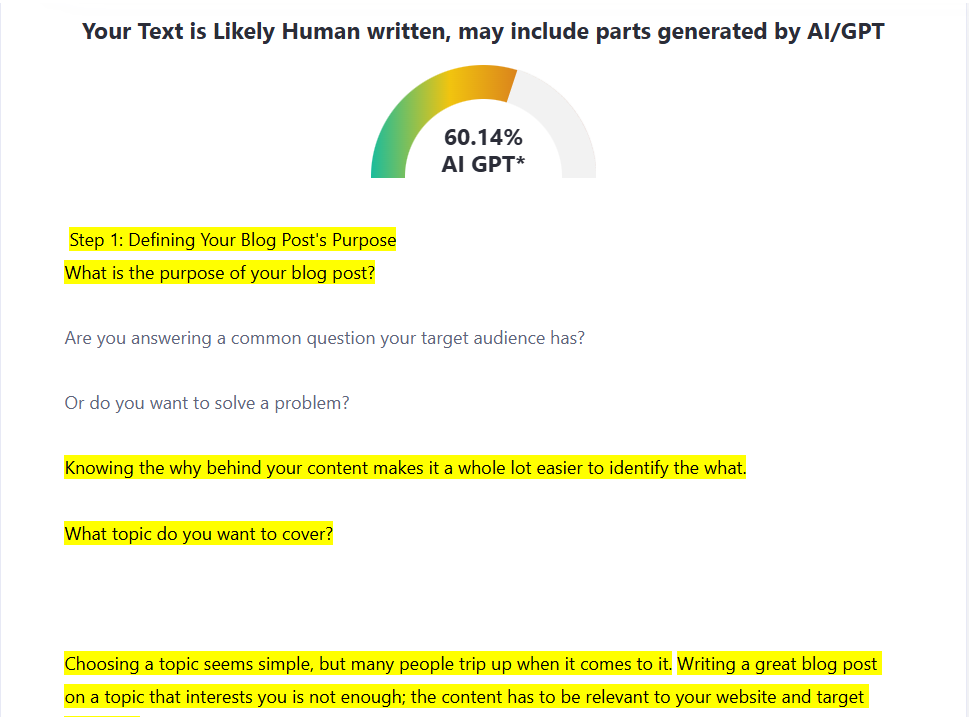
However, I then strategically added grammatical mistakes, which reduced the quality of my writing. Guess what happened? The likelihood significantly decreased.
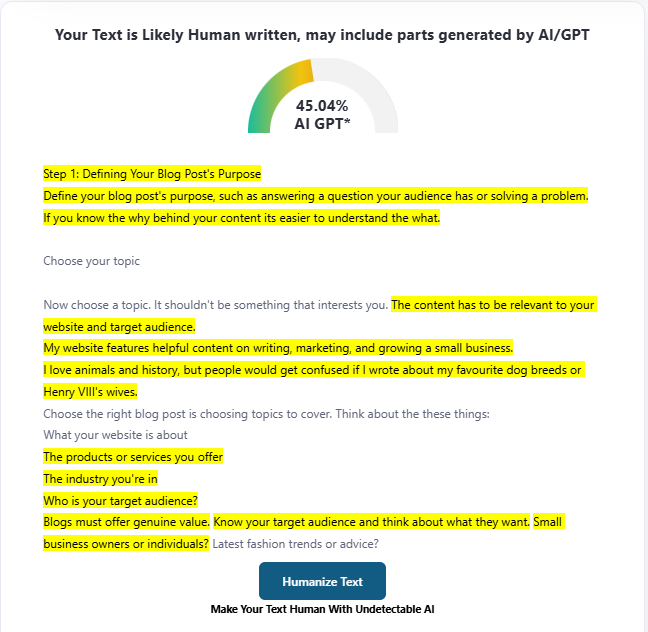
So, the less structured your writing is and the more errors there are, the higher the chances are of positive results.
The Dangers of False Positives
There are so many examples of false positives, where people have been accused of using AI tools. And it impacts both writers and students. When academics and businesses trust AI detectors over humans, it destroys relationships.
Take a look at these writing samples that large language models couldn't have possibly generated. But, AI-detection tools still registered a positive result:
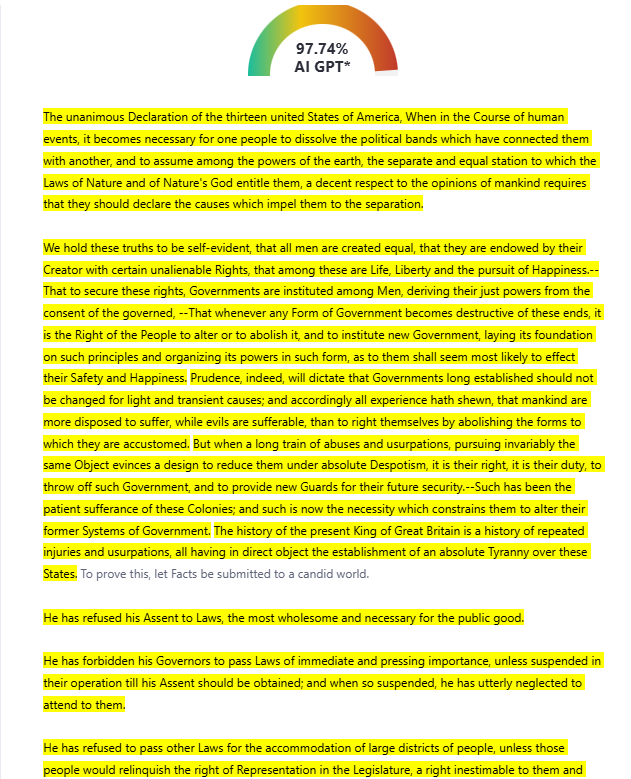
Declaration of Independence
Written long before generative AI tools were even created, the Declaration of Independence is apparently over 97% AI text.
The Bible
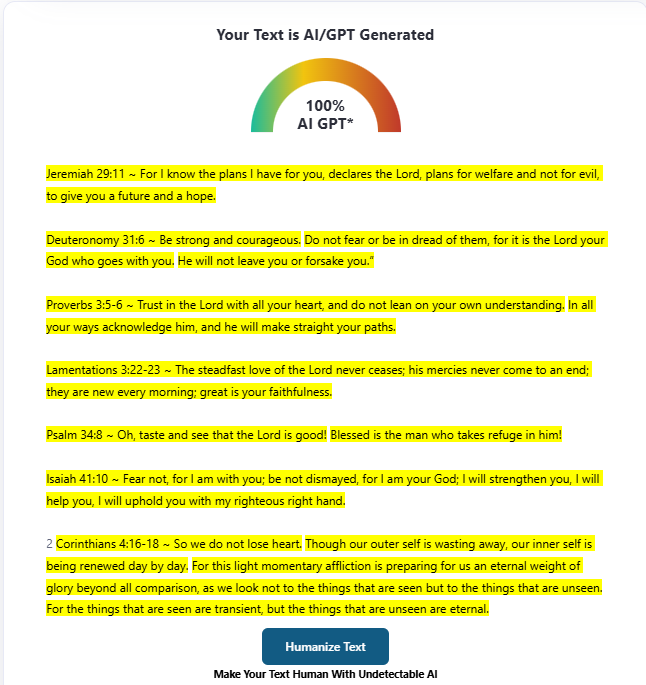
Yep, even one of the oldest books in the world isn't immune to AI! According to ZeroGPT, not a single word of these Bible quotes is human-generated.
Why Does Copy Written By A Human Get Recorded As AI-Generated Content?
It's ironic, really. The better your copywriter is, the more likely their work will be flagged as AI-generated text. Why? Because structured copy shares many characteristics with AI outputs.
Remember, AI isn't original; it uses human-written copy to generate content.
Copywriters Are Clear and Direct: We learn early on that our writing must be clear, concise, and free of fluff. AI tools follow the same pattern.
Tone Consistency: Both professional writers and AI tools maintain a consistent tone without waffling.
Simple Language: Again, we focus on simplicity and clear words. No jargon and BS. Same with AI tools.
So, a junior copywriter still honing their craft might bypass an AI detector, but a professional copywriter with concise, conversion-focused copy? Their text is more likely to be classified as AI-written.
The Real Consequences of False Negatives
So, we've covered false positives - but what about the other side of things? There have been cases where AI content has passed as human.
People using tools like ChatGPT have been able to bypass these detectors through simple changes - even though AI wrote the text!
A bit of prompt engineering, strategically adding some errors, and light paraphrasing can mean that the writing passes these detectors.
So, if you rely on these tools too much, you might end up with content that offers no original perspective, is full of errors, and has no real value... but it passes as human.
How to Know If Your Content Was Generated By AI or Written By A Human
Trusting a tool to detect AI is never a good idea. But, if you have concerns that your copywriter used ChatGPT or other detectors, then I recommend the following steps:
Ask Us
I'm always transparent about my process and happy to talk about how I create copy. This includes the research I did, the sources I referenced and how I created your copy. If you work with a copywriter who doesn't clearly demonstrate their processes, it's a red flag.
Look For Specificity
AI tools like ChatGPT are generic because they don't understand the specific details that make a business unique. Human copywriters write FOR your business and audience, so the output is always more specific and personal.
Check Your Brief
Good copywriters write to a brief. Can you see your brief reflected in the copy? Specific pain points you mentioned? Language that mirrors your audience? Details you provided in your onboarding? If yes, a human wrote it.
Even AI Detection Tools Warn About False Positives
AI models are trained on human data, and even the companies behind these tools acknowledge their limitations:
Turnitin: The most popular tool to check academic writing states that it has a 4% false positive rate. However, a study from San Diego University suggests a much higher rate. Students' academic integrity has even been questioned in some cases.
OpenAI: The company behind ChatGPT launched their own AI classifier in 2023. Within six months, they shut it down due to its "low rate of accuracy."
GPTZero: The AI and plagiarism detector has a disclaimer on its own website acknowledging that false positives occur and that results should not be used as definitive proof of AI authorship.
So, even these tools are telling people not to use them as the final word.
The Bottom Line: AI Detection Tools Do More Harm Than Good
AI detectors like to advertise themselves as solutions for businesses and academic institutions, but their inaccuracies are clear for anyone to see. The lines between human writing and AI tools are blurred because they're trained on human data!
Trusting tools like Originality.AI over the integrity of skilled writers doesn't just affect your business; it also forces copywriters to constantly lower the quality of our work.
Many copywriters responsibly use AI for research and outlines, but when you hire a professional, you can guarantee that the text is human.
Think of it this way: if you find someone on Fiverr charging $10 per hour, they're probably using LLMs. If you're willing to spend more on a professional, you get original copy packed with value.
Continue Reading: The AI Copywriting Series
Head back to the hub or explore the rest of the series:
📖 AI Copywriting: What It Can (And Can't) Do For Your Business
