
10 Healthcare Marketing Strategies That Actually Work
Getting patients through your doors shouldn’t feel unpredictable.
And yet for many healthcare providers, it does.
Referrals fluctuate. Online enquiries are inconsistent. One month feels strong; the next, quiet. Meanwhile, the healthcare landscape has changed dramatically. Patients research before they book. They compare providers. They read reviews. They expect convenience.
Traditional marketing — a basic website and the hope that word-of-mouth will carry you — simply isn’t enough anymore.
If you want steady, stable growth, your marketing needs to build trust, visibility and long-term patient relationships. That’s what the following strategies do.
Not quick wins. Not trends. Foundations.
What You Need to Know About Digital Marketing Strategies in Healthcare
As a healthcare provider, you’ll know that marketing can seem like an ongoing struggle. According to a Mintel Industry Report:

1. Build Trust Through Patient Stories (Not Generic Praise)
Healthcare decisions are rarely purely logical. They are emotional. Patients want reassurance that you understand their problem and can help them solve it.
This is why detailed patient stories are so powerful.
A short testimonial that says, “Great service, highly recommend,” doesn’t move the needle. A structured case study that walks through a patient’s journey does.
Effective patient stories typically include:
The patient’s initial concern or condition
Their fears or frustrations before treatment
Your diagnostic or treatment approach
The measurable outcome
How their quality of life improved
Specificity creates credibility. “Reduced pain by 60% in six weeks” holds weight. “Feeling better” does not.
Where appropriate (and fully compliant), visual records such as before-and-after imagery or progress updates can further strengthen trust. This works particularly well in specialities such as dermatology, dentistry, physiotherapy, and aesthetic medicine.
Video testimonials can also be incredibly effective. Seeing and hearing a real patient speak about their experience creates an emotional connection that written content often cannot mimic. The key is authenticity, not production value.
When handled professionally and ethically, patient stories are among your most persuasive marketing assets.
2. Strengthen Your Local Search Visibility
Most patients begin their search online. If your practice does not appear prominently in local search results, you are invisible at the exact moment someone is actively looking for care.
Local SEO isn’t complex, but it does require consistency.
Start with your Google Business Profile. Ensure every section is complete and accurate, including opening hours, service descriptions and professional imagery. Keep it updated with relevant posts such as new services, health advice or practice announcements.
Reviews play a central role in both search visibility and decision processes. Develop a simple, ethical system for requesting reviews from satisfied patients. The most effective time to ask is shortly after a positive experience. Make the process easy by providing direct links or QR codes.
Consistency is equally important across all online directories. Your practice name, address and phone number must be identical everywhere — including healthcare directories, insurance listings and local business platforms. Even minor inconsistencies can weaken search engine trust.
Local visibility is not about gaming the algorithm. It is about clarity, consistency and credibility.
3. Position Yourself as A Thought-Leader With Educational Content
Patients search for answers long before they search for a provider.
If your website offers clear, helpful, jargon-free explanations of the conditions you treat, you become a trusted source of information before a patient even contacts you.
Focus on the conditions and treatments you most frequently provide. Structure content around:
Symptoms and warning signs
Causes and risk factors
Treatment options
What patients can expect
When to seek professional care
The goal is clarity, not complexity. If you would not explain something in excessively technical language during a consultation, do not write it that way online.
Downloadable guides and checklists can further strengthen this strategy. Pre-appointment preparation guides, recovery checklists and chronic condition management resources all provide genuine value while also supporting your patient acquisition efforts.
Video content can complement written content by explaining procedures, tackling common fears and outlining what to expect during a first visit. This reduces anxiety and builds familiarity.
Educational marketing works because it demonstrates skill without overselling.
The key to creating engaging content that prospective patients want to see? Developing a content strategy that covers each part of the patient journey.
4. Humanise Your Practice Through Social Media
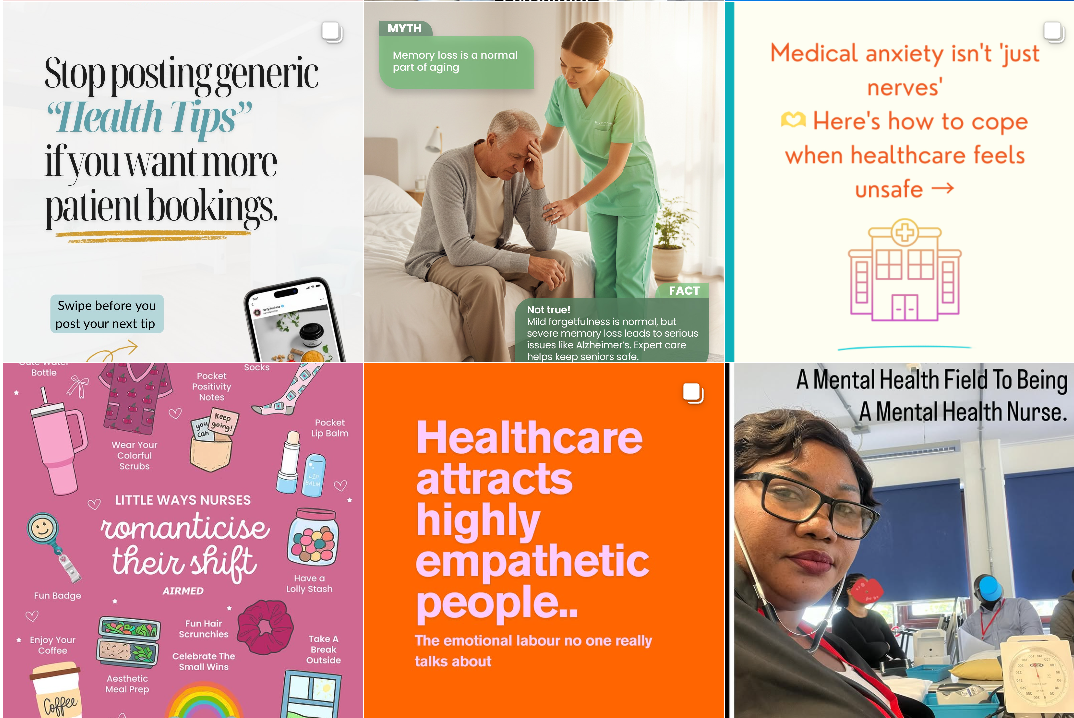
Healthcare can feel intimidating. Social media gives you an opportunity to make your practice feel more approachable.
This does not mean posting randomly. It means showing the people and values behind your services.
Exclusive behind-the-scenes content, team introductions, professional development, and community involvement all reinforce that your practice is built on real people who care about medical outcomes.
Live Q&A sessions can be especially effective when focused on one clear topic. Addressing seasonal health concerns or common patient questions in real time builds authority while encouraging engagement.
Awareness campaigns aligned with relevant health months or seasonal concerns can also increase reach, particularly when designed to be shareable and educational.
The objective is not constant promotion. It is relationship-building.
5. Use Structured Email Communication
Email remains one of the most underused tools in healthcare marketing.
Automated appointment reminders reduce no-shows and boost operational efficiency. Follow-up emails containing care instructions or recovery guidance reinforce your professionalism and attentiveness.
Segmentation substantially enhances performance. Different age groups, conditions and service types require different communication. Personalised messaging increases engagement and strengthens patient relationships.
A structured welcome sequence for new patients may further improve the experience. Introducing your team, outlining processes and outlining expectations early builds confidence and reduces uncertainty.
When used strategically, email supports both retention and patient satisfaction.
6. Develop Strong Referral Partnerships
Growth does not happen in isolation.
Establishing professional referral relationships with complementary providers creates mutual value and consistent patient flow. Clear communication, defined processes and reciprocal referrals are key to making these partnerships sustainable.
Participation in community health events can also strengthen local visibility while building professional connections. These environments provide opportunities to demonstrate expertise and build relationships beyond transactional referrals.
A strong referral network becomes one of the most stable sources of lasting growth.
7. Prioritise Patient Retention
Acquiring new patients is important. Retaining existing patients is more cost-effective and often more profitable.
Consider developing structured health packages that bundle related services into comprehensive care plans. Annual wellness programmes, family health bundles or chronic condition management packages provide convenience while increasing lifetime value.
Personalised communication — such as milestone reminders or preventative screening prompts — reinforces ongoing engagement.
Retention strategies work because they deepen trust over time.
8. Use Paid Advertising
Organic marketing builds foundations. Paid advertising accelerates results when executed strategically.
Google Ads can capture high-intent searches for specific conditions or services. The key is targeting specific phrases rather than broad terms and directing traffic to dedicated landing pages which match search intent.
Social media advertising allows for geographic and demographic targeting, making it effective for local healthcare services. Educational video content often builds trust and helps introduce your practice to new audiences.
Retargeting campaigns can re-engage website visitors who did not initially book an appointment. Often, a second exposure with reassurance or additional information is enough to convert interest into action.
Paid advertising should be measured carefully to ensure a sustainable return on investment.
9. Optimise for Mobile and Convenience
Most healthcare searches now occur on mobile devices. A slow-loading or difficult-to-navigate website can immediately drive potential patients elsewhere.
Ensure your site loads quickly, uses optimised images, and offers clear calls to action that work flawlessly on smaller screens.
Online booking is increasingly expected. Allowing patients to schedule appointments 24/7 improves convenience and lowers administrative workload.
Where appropriate, virtual health services can further expand accessibility and increase patient satisfaction.
Convenience influences choice.
10. Measure, Analyse and Refine
Marketing without measurement becomes guesswork.
Monitor patient acquisition costs across channels to understand which strategies deliver the strongest return. Monitor online reputation and spot recurring themes in feedback. Review website analytics to determine which pages convert effectively and where improvements are needed.
Most importantly, ask patients directly how they discovered your practice. This simple question often reveals findings that analytics alone cannot provide.
Continuous improvement guarantees your marketing develops alongside patient expectations.
Final Thoughts
Healthcare marketing does not need to feel overwhelming. It needs to be intentional.
When it comes to digital marketing strategy, healthcare providers should understand that patients aren’t searching for the largest practice or the most aggressive advertiser. They want a provider they can trust — someone who understands their concerns and offers clarity.
When your marketing displays expertise, understanding and professionalism, growth becomes more predictable.
Start by strengthening one or two foundational areas. Implement them thoroughly. Measure the impact. Then expand.
Sustainable growth is built on clarity, not noise. If you need some help with your marketing strategy, I offer a range of convenient packages with no monthly tie-ins, including the Marketing Made Easy Package.
