
AI Copywriting: What It Can and Can’t Do For Your Business
Small businesses face a lot of challenges. From competing with smaller budgets to handling every aspect of your marketing, it’s easy to feel overwhelmed - especially when it comes to creating website copy and blog posts.
AI copywriting tools promise to deliver speed and flexibility. Can they save you hours? Absolutely. Are they worth it? Well, that depends.
I’m not here to tell you not to use AI for copywriting, but it’s important to understand what AI can and can’t do for your business.
That’s what I’ll cover in this guide.
Read on to find out:
What AI does well
What it can’t do
The costs of using AI incorrectly
Whether your business should use AI copywriting
How I use AI in my own process
AI copywriting tools worth knowing about
What Is AI Copywriting?
AI copywriting is the use of artificial intelligence tools to create written content, such as website copy, blog posts, and email campaigns.
These tools don't magically generate ideas; they're trained on existing internet content. So, when you give them a prompt, they'll generate text based on the information they've learned from millions of human-written sources.
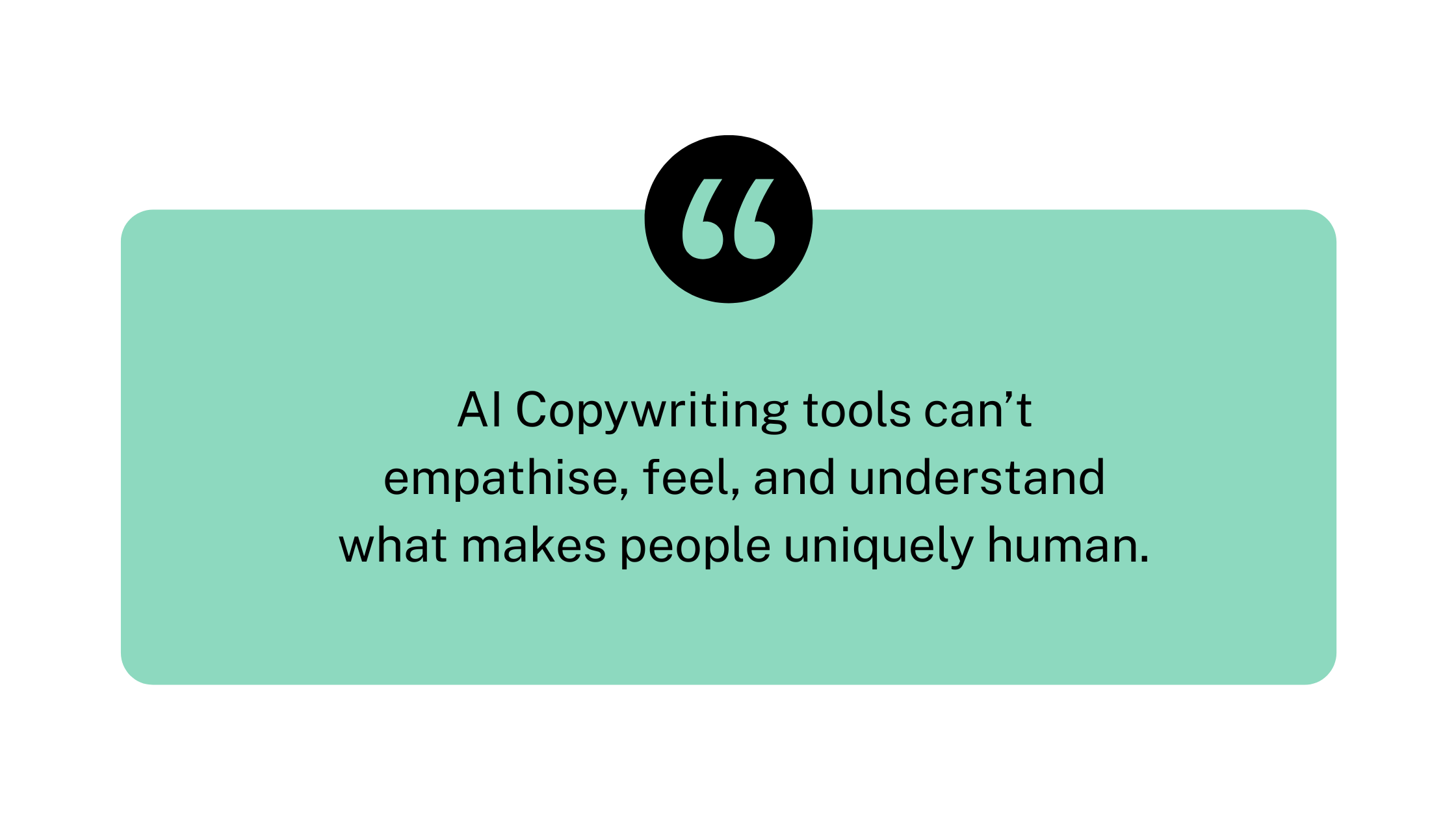
But these tools don't understand your audience, they don't feel, and they can't empathise.
I’ll give you an example here:
A couple of months ago, I had an email from a potential client. She’d used ChatGPT and AI copywriters to create her homepage and main service pages, but couldn’t understand why her website wasn’t generating leads.
The content was technically fine and well optimised, but it sounded like nobody. There was no personality, no warmth, and nothing that would say “Wow, this lady really gets me” to her visitors.
And that’s the problem with AI copywriting. It reads fine and looks good… but it’s not unique. Most importantly, it’s forgettable.
What AI Copywriting Tools Do Well
AI isn’t going anywhere, and in my personal opinion, it shouldn’t. Market estimates predict that artificial intelligence will be worth over USD 5 billion by 2032.
While some copywriters will say that AI shouldn’t be part of the process at all, there are things it does well. And, if you’re a small business, AI can save you a lot of time and money.
Generating First Drafts Quickly
Nobody likes to stare at a blank screen (and yes, it even happens to copywriters like myself). AI writing tools like ChatGPT and Claude can offer a starting point.
If you need to get something on the page fast or just want some inspiration, they can offer it. But the important words to remember here are starting point.
Brainstorming Headlines and Ideas
Another thing AI excels at? Brainstorming. If you’re struggling to come up with ideas for email subject lines and product descriptions, these tools can give you a push in the right direction.
Are most of them generic? Absolutely. However, buried in 30 subject lines, there might be the roots of an idea that you can make uniquely yours.
Repurposing Existing Content
When you’re a small business owner, time is money. Staying active on multiple marketing channels is hard, but this is where AI really shines. For example, you can take a blog post and transform it into social media posts.
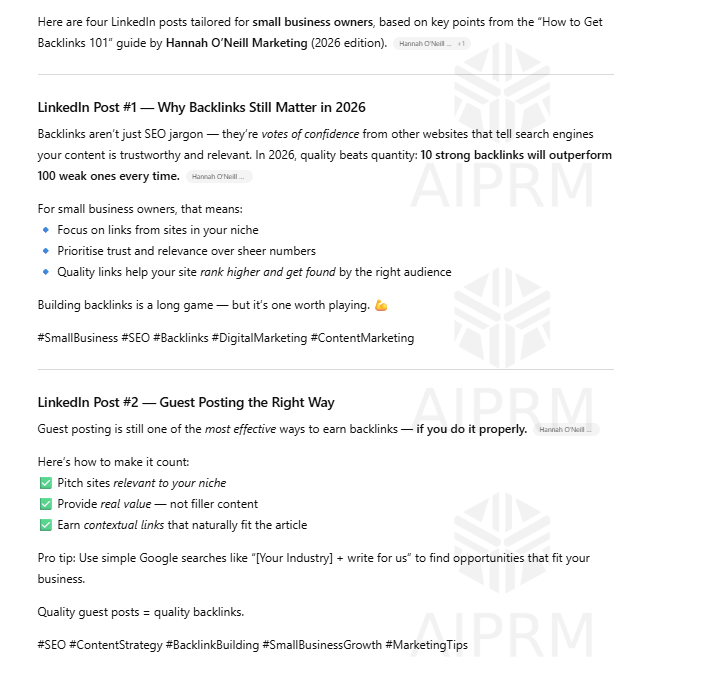
I did the same with one of my blog posts. I used ChatGPT with this exact prompt:
Turn this blog post into four LinkedIn posts with hashtags. Extract four key points from the content and target them to small business owners.
Here’s what it delivered:
Routine, Repetitive Copy
We often associate copywriting with creativity, but it can get repetitive. Creating product descriptions for over 200 items, meta descriptions and titles, FAQ answers…AI saves time without compromising quality.
Basic SEO Frameworks
AI tools can be beneficial for creating keyword-optimised outlines. It doesn’t replace a detailed SEO strategy, but you can speed up your scaffolding work. Take a look at this example:
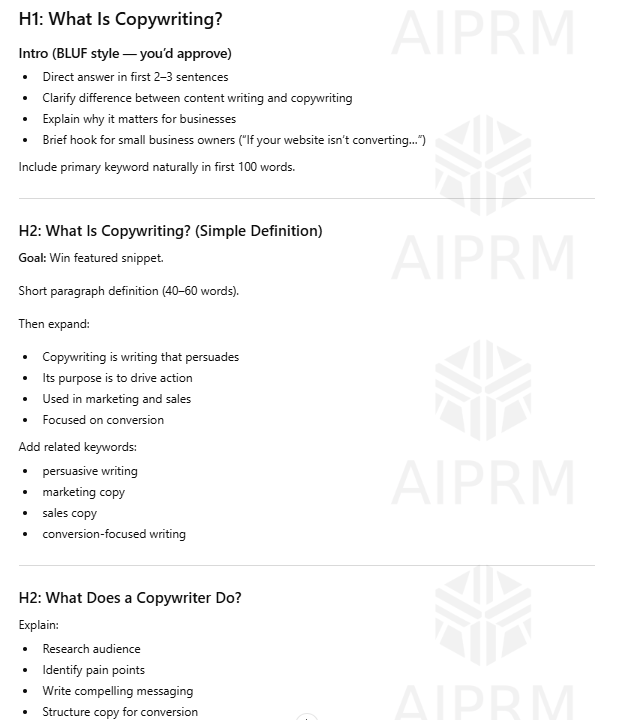
Again, you should think of AI as a helping hand, not a definitive output.
Want to see exactly how AI and human copy stack up in a real head-to-head test? Read: AI Copy vs Human Copy: The Showdown
What AI Copywriting Can't Do
Now it’s time to look at what AI doesn't do well. This is often where most small businesses learn expensive lessons with their marketing strategy. So, let’s take a look at what AI copywriting tools can’t do.
AI Won't Sound Like You
Brand voice isn’t just for the big corporate guns. It’s what separates your small business from the competition and tells people why they should choose you. Even if you train an AI model to replicate your tone of voice, there are still some limitations.
The copy will sound like a business, but it won’t necessarily sound like your business. So you get copywriting that reads well and is grammatically correct, but lacks that pizzazz.
Understand Your Audience on a Human Level
AI may assist with research and data analysis. It can tell you where your audience hangs out and who your competitors are… but it can’t get inside your audience's heads. Artificial intelligence lacks empathy and human emotion.
As copywriters, our success lies not just in understanding what our target audience wants, but also in understanding why they want it and what ultimately makes them take action.
Think of it like this: Human writers empathise; AI pattern matches.
Make Strategic Decisions
Despite its superior data analysis abilities, AI should be part of the decision-making process, NOT the entire story.
For example, you can use AI to compare your messaging to competitors or assess how many people click on your CTAs, but it doesn’t have the empathy and understanding to make human-centred decisions.
Write With Genuine Emotion
Here’s where people often get confused. AI might seem like it’s writing with emotions, but naming feelings and actually understanding them are two very different things.
For example, an AI copywriting tool might say, “X product will make you feel empowered and confident.” It sounds good, but that doesn’t mean that your audience will connect with the message.
Great copywriting doesn’t sell; it makes your audience feel something. That's why using AI to write your website copy isn't a good idea.
Build Trust With Real People
Humans are remarkably good at detecting inauthenticity. Not always consciously — but a piece of copy that feels slightly off, slightly generic, slightly "not quite right" demonstrates trust in ways that are hard to measure but very real in their impact.
Worried your copy might already have that AI feel? Learn the warning signs. Read: 5 Signs Your Copy Was Written By AI (And Why It's Costing You Sales) →
The Costs of Using AI for Your Business Copy
The problem with AI-generated copy isn’t its output; it’s the fact that it costs opportunities for your small business. If you sound like everyone else, then how will people know what makes you unique?
What will make them say, “Yeah, this business really gets me”?
AI content is NEVER original. It can’t be! These tools rely on existing copy. Sure, they might rewrite it, but it’s still nothing new for your audience.
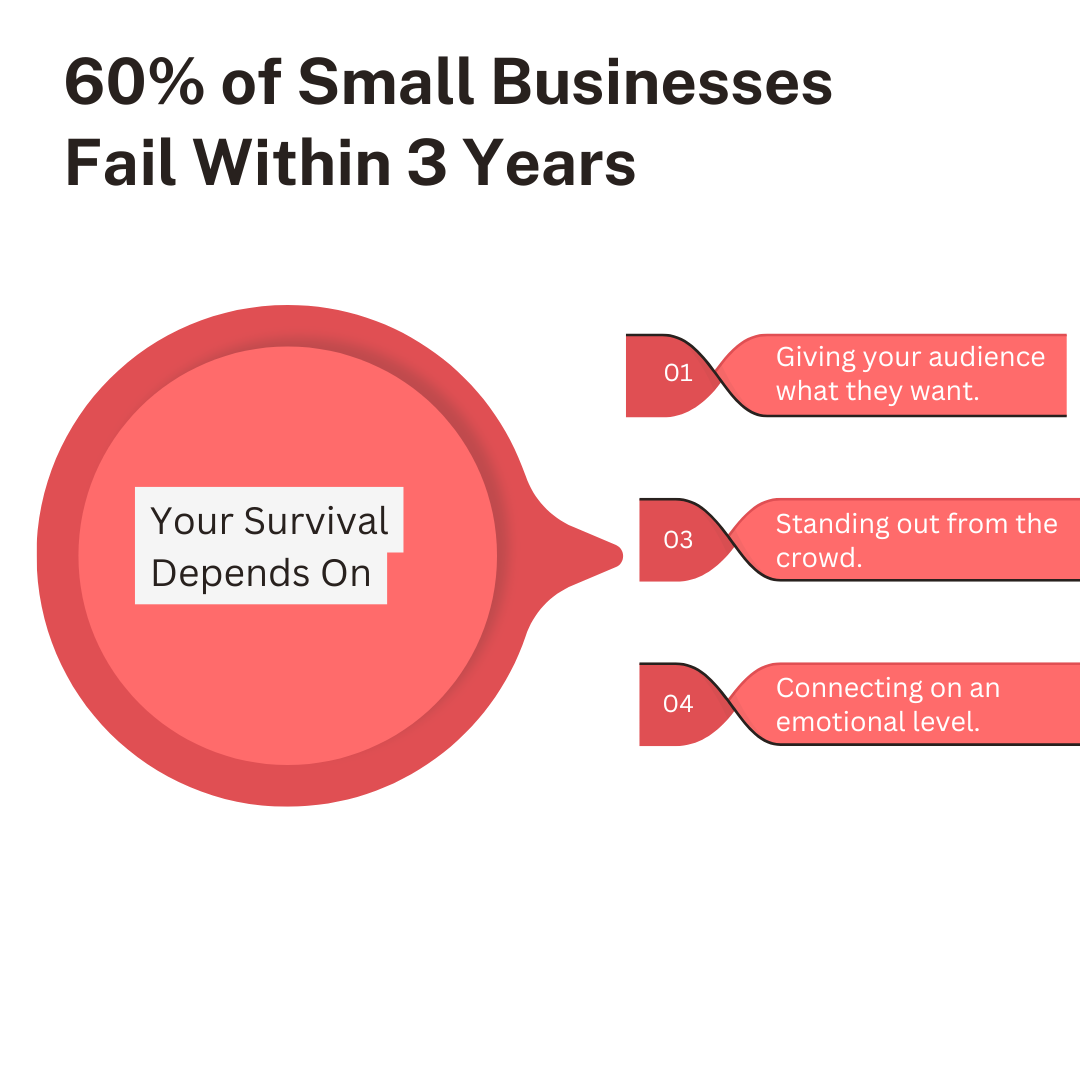
Around 60% of small businesses in the UK fail within their first three years, and your survival depends on three things:
Giving your audience what they want.
Standing out from the crowd.
Connecting on an emotional level with your audience.
If your audience feels your content is generic, uninspiring, and fails to make them feel anything, you’ll lose them.
Plus, AI tools can get expensive. In many cases, you’ll often save more money by hiring a copywriter.
Should I Use AI For Content Creation?
I’m not going to tell you that you categorically shouldn’t use AI for content creation because it does offer some benefits. But how you use it matters more than whether you use it at all.
AI Works Well For:
Brainstorming: Stuck for ideas? Using an AI tool can provide inspiration for blog topics, social media posts, and outlines.
First Drafts: Writer’s block is a horrible thing (even us copywriters get it). Sometimes, AI tools can be beneficial for creating a first draft. However, this should only be a starting point.
Repurposing Content: Long-form blog posts are ideal for repurposing. You can turn them into social media posts, podcast scripts and even videos with AI.
Mundane Copy: Creating product descriptions, meta descriptions and other mundane copy is boring. AI tools can speed up the process significantly.
AI Isn’t Good For:
Creativity: Your homepage, service/product pages, and about pages should be original, on-brand, and evoke emotions in your target audience.
Conversion-Focused Copy: Emails and landing pages can skyrocket your conversion rates - when they speak to your audience. AI tools don’t have the empathy and understanding of a human writer.
Thought Leadership: Whether you’re writing a case study, whitepaper, long-form blog post, or anything else that requires original perspectives, AI tools can’t deliver true value. They rely on existing content.
How I Use AI Tools in My Own Writing Process
I work with small businesses, and transparency is a massive part of my process. So I’ll be honest: I do use AI as part of my process.
However, I never use tools for the writing part, because I understand the importance of human understanding, emotion, and empathy.
Here’s how I integrate tools into my process:
Research assistance: I use AI to quickly summarise topics, gather background information, and identify angles I might not have considered.
Outline generation: If I'm staring at a blank brief, I'll sometimes ask AI to suggest a structure — then I'll pull it apart and rebuild it around what I actually know needs to happen strategically.
Headline brainstorming: I'll generate a list of options, then select and rewrite the ones with potential.
Editing support: Checking for clarity, flow, and readability.
What I never do: Let AI write the final copy. Not a headline. Not an opening line. Not a CTA.
The moment AI writes the words your audience reads, you've handed over your brand voice to a machine that has no idea what makes your business worth choosing.
Want the full breakdown of how a professional copywriter uses AI (and where to draw the line)? Read: How I Use AI in My Copywriting Process (Without Letting It Write For Me).
The Best AI Copywriting Tools for Your Small Business
If you're going to use AI tools, some are better than others. Here are my top picks:
ChatGPT (OpenAI)
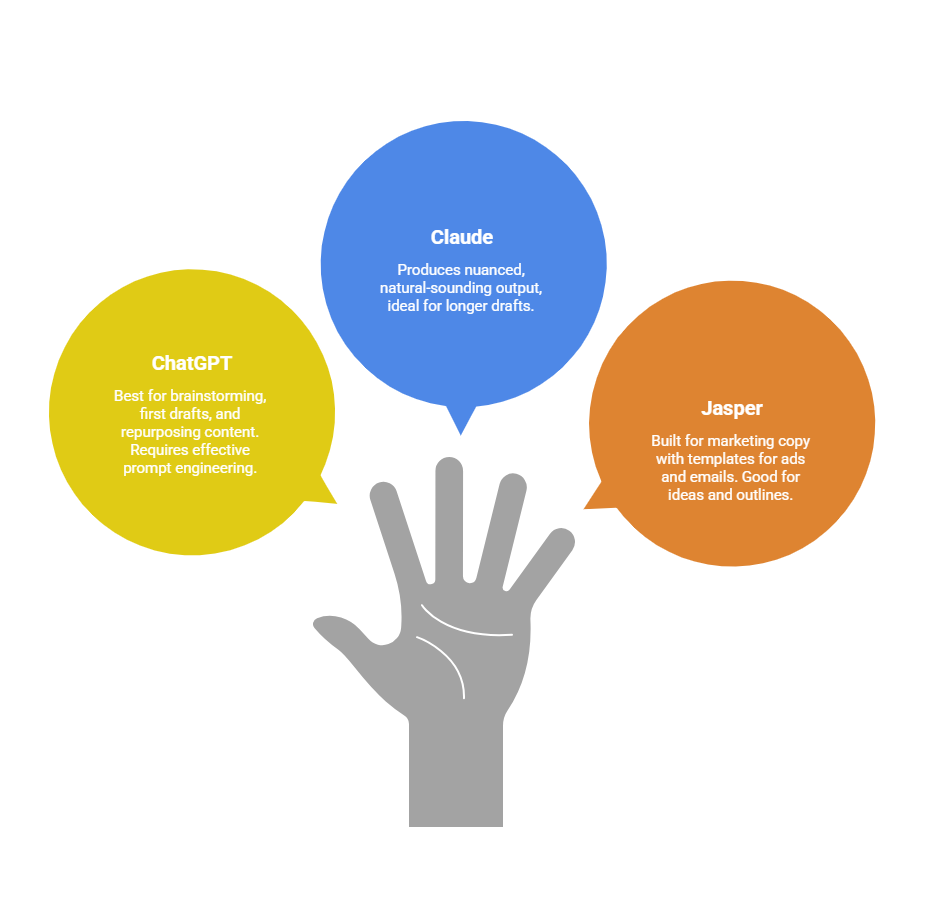
As the most widely used AI writing tool, ChatGPT is great for brainstorming, first drafts, and repurposing long-form content.
But you'll need to learn to use prompts effectively to achieve useful output.
Claude (Anthropic)
Often produces more nuanced, natural-sounding output than ChatGPT. It's good for longer-form first drafts.
Jasper
Jasper is built for marketing copy, and it has templates for ads, landing pages, and emails. Again, I wouldn't recommend using it to create content, but it's good for ideas and outlines.
The Honest Verdict on AI Writers
AI tools are exactly that: tools. A doctor might use a symptom checker to assess what might be wrong with a patient, but they'll still speak to the patient, assess them and use their human intelligence to diagnose the issue.
It's exactly the same with using AI tools for copywriting. Every copywriter and marketer knows that they can't replace the human element, and will never be able to offer creativity, originality, and empathy.
Use them to speed things up and remove writer's block, but don't trust them to manage your content for you.
The Bottom Line
AI copywriting is a genuine innovation that's changed how content gets made. It's faster, cheaper, and more accessible than anything we've had before.
But speed and accessibility aren't the same as quality. Great copywriting isn't about nice words and grammatically correct sentences; it's about nuance and results.
The businesses that will win with content in the next decade aren't the ones that use AI for everything. They're the ones who use AI smartly — for the right tasks, in the right way — and know exactly when a human needs to take over.
Your homepage needs a human. Your sales page needs a human. Your email welcome sequence needs a human.
Everything else? Use your judgment — and use AI as the tool it is, not the copywriter it isn't.
Tired of blank screen syndrome? Let me handle the copy.
Whether you need a full website refresh, high-converting email sequences, or ongoing copywriting support — I write copy that sounds like you and gets results.
Start With a Website Quick Wins Audit - £97
Continue Reading The AI Copywriting Series
Want to learn more about AI copywriting? Check out the rest of my series:
AI Copy vs Human Copy: The Showdown → A head-to-head comparison across real copy examples — homepage, email, landing page. Who wins?
5 Signs Your Copy Was Written By AI (And Why It's Costing You Sales) → If your copy ticks any of these boxes, it might be time for a rewrite.
Why You Shouldn’t Trust AI Detectors → The honest breakdown of why professional copywriters don’t trust AI detectors, and you shouldn’t either.
Frequently Asked Questions
What is AI copywriting?
AI copywriting is the use of artificial intelligence tools to generate written marketing content — including website copy, emails, blog posts, and social media captions. Tools like ChatGPT, Jasper, and Claude use machine learning to produce text based on patterns from existing human-written content.
Can AI copywriting replace human copywriters?
Nope, it can't - even though some 'influencers' will tell you otherwise. AI can generate text quickly, and that text might seem great. However, it can't create a genuine emotional connection with your audience or offer originality.
Is AI copywriting good for SEO?
AI can help with keyword integration and content structure. However, Google's helpful content guidelines prioritise original, experience-led content written for humans. Purely AI-generated content — especially without significant human editing — often lacks the depth and authenticity that ranks well long-term.
What are the best AI copywriting tools for small businesses?
The most widely used tools are ChatGPT, Claude, Jasper, and Copy.ai. For SEO-focused content, Surfer SEO with AI integration is worth exploring. Each has different strengths — ChatGPT and Claude are the most versatile starting points for most small business owners.
How can I tell if the copy was written by AI?
Common signs include generic phrases ("innovative solutions," "in today's fast-paced world"), lack of specific personality or brand voice, predictable sentence structures, and content that could apply to any business in your industry.
Should you use AI to write your website copy?
For your homepage, About page, and service pages — no. These are your highest-stakes conversion pages and require strategic thinking, brand voice, and genuine audience understanding that AI can't deliver. For lower-stakes content, such as social captions or meta descriptions, AI can be a useful time-saver. But most outputs still require human editing.
How much does AI copywriting cost vs hiring a human writer?
AI tools typically cost £15-100/month for subscriptions. Are they usually cheaper outright? Yes. But you also need to factor in the time it takes to prompt, edit, and rewrite. Also, a professional copywriter focuses on brand authority, conversions, and long-term loyalty. All of these can increase your ROI.
What's the difference between AI copywriting and AI content writing?
Copywriting refers specifically to persuasive, conversion-focused writing — designed to get people to take action. Content writing is broader and includes educational articles, guides, and blog posts. AI struggles more with copywriting than with content writing, as conversion copy requires strategic thinking and emotional intelligence beyond pattern-matching.
